
Embracing Insurgency: Memories of Mexican Independence
Together, these sources reveal the evolution of insurgency in Mexico on a global scale. The letter written from Villahermosa, Tabasco in Mexico shows the terror of Manuel Hidalgo. That terror reached Philadelphia, where Spanish Ambassador Onís warned the Mexican Viceroy of Hidalgo’s threat. The map printed in Scotland in 1814 showed the magnitude of the insurgency’s threat. All of these sources establish a pattern of fear of insurgency within Latin America, however, 70 years later, Hidalgo’s Family Tree changed the perspective from terror of insurgency to the celebration of heroes. This shift reflects how once feared insurgents gradually incorporated themselves into Mexico’s national memory and illustrates how foreign and domestic perceptions of insurgency transformed a nation’s identity.
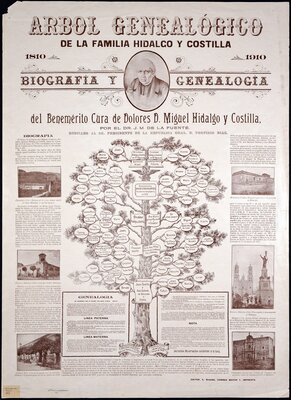
Family Tree: Hildago y Costilla
An artful depiction of the Hidalgo y Costilla family tree, with dates ranging from 1810 to 1910. Positioned in between Mexican statues and buildings grows a tree with branching limbs containing the vast members of the Hildago y Costilla family. Above them all is a stunning portrait of Miguel Hildago y Costilla, the father of Mexican Independence. The trunk of the tree contains the first and founding members of the family, with the branches and limbs containing the descendants that proceeded. In this time period, it was common that those who fought against powerful monarchies often faced consequences that saw to the demise of family lineage. Contrarily, the object conveys the predominance the Hildgao family had in Mexico and the scope of its growth; a once humble priest and rebellious freedom fighter against the Spanish monarchy has beat the odds against the crown and now has seen his legacy grown into a powerful and influential family. The source not only shows the pedigree of an influential Mexican family, but how perceptions of actors of insurgency and how were remembered changed over time.
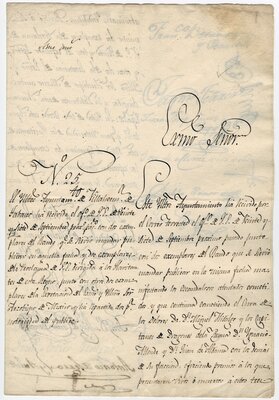
Letter from the Ayuntamineto of Villacehermosa to Viceroy Franciso Xavier Venegas
This letter, written in 1810 by the Ayuntamiento of Villahermosa to Viceroy Francisco Xavier Venegas, reveals the fear Miguel Hidalgo inspired when he rose against Spanish authority. The document shows colonial officials attempting to halt the revolution by warning Hidalgo and his followers, even declaring their intent to capture or kill them. As Gueda notes in “The Process of Mexican Independence”, Spanish leaders saw Hidalgo not simply as a rebel but as the embodiment of widespread discontent that threatened the stability of colonial rule. Understanding this moment is crucial, for it marks both the beginning of Mexico’s independence movement and the first signs of Spain’s imperial decline.

“Cartas de Luis de Onís al Virrey de México"
A large red seal formalizes a letter by Spanish Ambassador to the United States, Luis de Onís, who was in Philadelphia writing to the Viceroy of Mexico. This letter contains information about Napoleonic agents acting within Latin America and correspondence with the United States government. It is a useful tool in establishing who the many different forces were within the early 19th century and how they interacted with each other in light of Napoleon's invasion of Spain. Onís’ letter ties Spain, France, Mexico, and the US into an overarching picture. Some may know about the Napoleonic Wars, but the impact they had on Latin America is frequently overlooked. The scope of who was involved, namely the United States, is even more so.
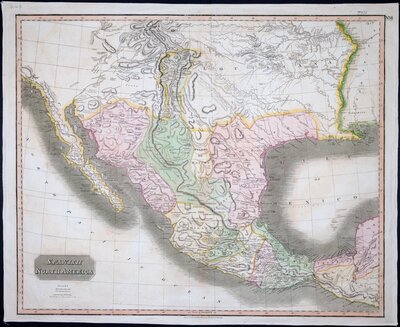
Map of Spanish North America (1814)
Scottish cartographer John Thomson's map of Spanish North America, printed in 1814, is hand-colored, showing Mexico and its provinces in the midst of a revolution against Spain. The map is based on the voyages of the German explorer Alexander von Humboldt and American explorer Zebulon Pike. While at first glance the map appears as a familiar Mexico, when looking closer, you notice provinces are color-coded to convey Spain's control. Pink territories show insurgent control, yellow highlights unpopulated/missionary territories, and green territories show the concentration of loyalism in the center of Mexico. Above the border, there are labels for Native American territories as well as labels for the United States and French territories. This map gives valuable insight into the international perspective on progression of the Mexican Revolution following the Cadiz Constitution and mirrors the revolution from a geographical standpoint.