
Representations of Authority
Despite being from two far-away places in time and space, these two written documents show how they worked to define authority and reinforce hierarchies while also suggesting how fragile authority and hierarchy could be. The hacienda inventory from early eighteenth-century Zacatecas shows the colonial economy’s dependence on land and enslaved labor, where value was calculated through property and people. “¡Viva la Federación!” celebrates supposed national unity under Juan Manuel de Rosas after the Argentine War of Independence, using political language to assert their unrelenting power over the “savage” Unitarians. Together, the two pieces trace a shift from colonial control to post-independence political turmoil.
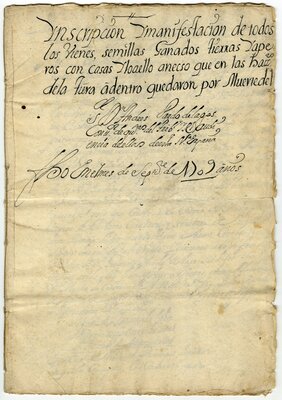
Black Diaspora in New Spain
This written document is a hacienda inventory created in 1709 in Zacatecas, Mexico. It lists property items such as cattle, tools, land, and enslaved people, each with an assigned monetary value. The inventory was created by colonial officials to record the assets of an estate for taxation and inheritance purposes. As Robert Ferry explains in “Encomienda, African Slavery, and Agriculture in Colonial Mexico,” such records show how slavery and agriculture were closely connected in the colonial economy. They also show the administrative systems that made forced labor appear ordinary and manageable. Many visitors might think slavery in Spanish America was limited or unorganized, but this inventory proves how the colonial government documented enslaved people as property within an efficient economic structure. Colonial record keeping helped sustain a system that normalized inequality and exploitation.

¡Viva la Federación!
In this large, leather-bound book, Brigadier General Manuel Oribe writes a report to Juan Manuel de Rosas. Printed on thin, delicate pages, Oribe describes a battle won against the "savage" Unitarian Juan Lavalle, complete with battle maps displaying the various army regiments across the field.
When the Argentines won the May Revolution of 1810, disagreements arose between the Unitarians and the Federalists in the province of Buenos Aires. Rosas, the leader of the Federalist party and governor of Buenos Aires from 1835 to 1852, was considered by his detractors a dictator. His style of leadership was harsh. In 1833, Rosas ordered his subjects to wear red lapel ribbons as a public display of their support to the Federalist regime, and opposition towards the "savage, filthy Unitarians". Police patrolled the streets of Buenos Aires, ensuring compliance under threat of corporal punishment, or in some cases, execution. Rosas eventually fled to England after his defeat in the Battle of Monte Caseros in 1852 after ruling with an iron fist for seventeen years.