
Constitutional Experimentation
The objects shown here demonstrate the complex process of early constitution-writing and state-building in Hispanic America. The Proclamation shows the Cadiz Constitution being used to persuade against independence and pledge colonial loyalty, demonstrating it as a major influence in Spanish America. The translated U.S. Constitution and speeches by George Washington, however, showcase a democratic influence on local political discourse following revolution. Lastly, the plans each represent early liberal constitutional outlines, which proposed substantive reforms while also clinging to traditionalism. Despite not all being formally adopted, each of these documents contributed to constitutional experimentation that would shape the trajectory of early Hispanic American states.
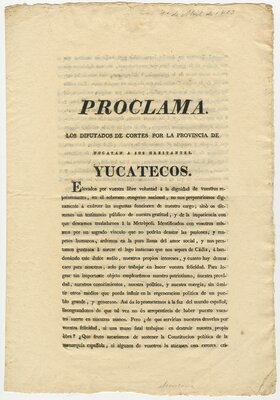

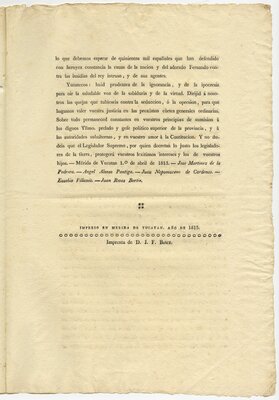
Proclamation from The Deputies to the Cortes for the province of Yucatán
This three page printed governmental proclamation, shaded in a yellow hue with frayed edges marks the increasing passage of time. The proclamation was published in 1813 by the deputies of the legislative assembly for the Yucatan province, pledging allegiance to Spain through the Cadiz Constitution set a year prior and persuaded citizens to not engage in acts of rebellion and independence. However, during the time Yucatan's neighbor, Mexico, had already been experiencing acts of rebellion towards a fight for independence from Spain. The Cadiz Constitution marked for its progressive and liberal reforms has been often seen as an influence for revolution but within this document the constitution is used to persuade citizens away from the inevitable waves of independence.
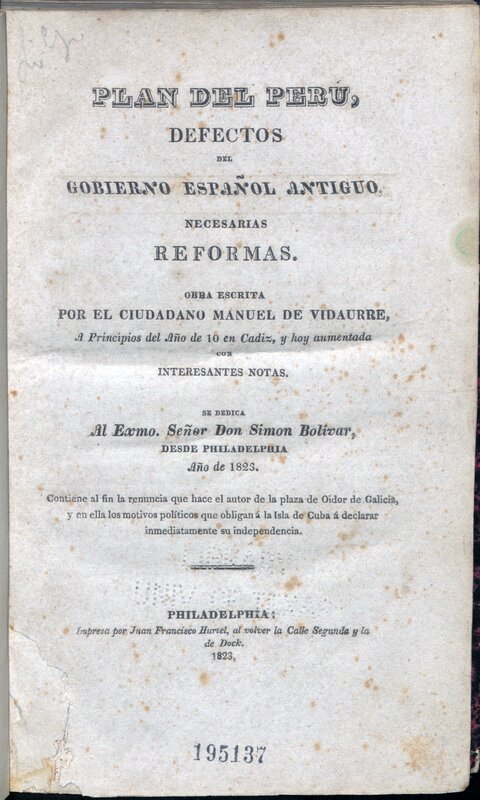
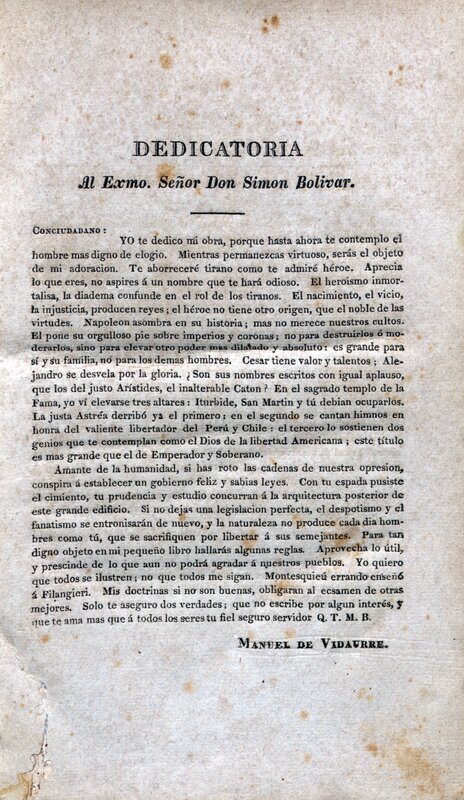
Plan Del Peru
Published in Philadelphia in 1823, Plan del Perú by Manuel Lorenzo de Vidaurre details the political vision of a newly independent country. Vidaurre, a Peruvian activist and former judge, laid out his plan to rebuild Peru through new education reforms, infrastructure and labor laws, and reforms to the local governance system. He believed the new nation should replace the injustices brought on by Spanish colonial rule, creating a government that serves the people and holds political figures accountable rather than serving the powerful elites. The book includes a dedication made to Simón Bolívar, who Vidaurre honors as the “liberator of the Americas” but warns him not to fall into dangers of tyranny. Through this book, Vidaurre hoped to guide Peru towards freedom by shaping a nation governed by law and responsibility.
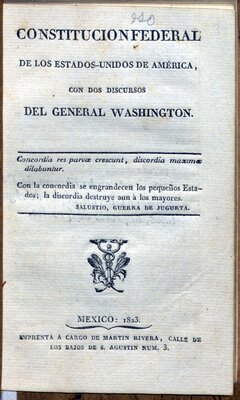
Translated U.S. Constitution from Mexico, 1823
In 1823, a Spanish translation of the United States Constitution, along with a collection of George Washington’s speeches, was printed in Mexico. Two parallel winged snakes intertwined around a feathered staff adorn the center of the title page, forming a traditional caduceus. This symbol represents diplomacy, eloquence, and trade, indicating the exchange of republican ideals found in these U.S. sources across the U.S.-Mexican border. Unique to other Mexican liberal texts of the time, this translation showcases that early nineteenth century Mexicans were influenced by foreign materials. The presence of U.S. foundational republican documents and speeches in Mexico, a year prior to the promulgation of Mexico’s first federal constitution in 1824, suggests that United States’ Republicanism may have been a useful example in the drafting of Mexico’s premiere constitution.
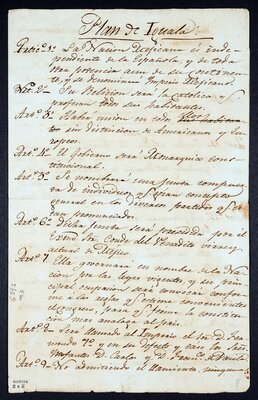
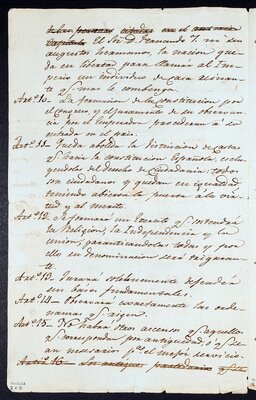
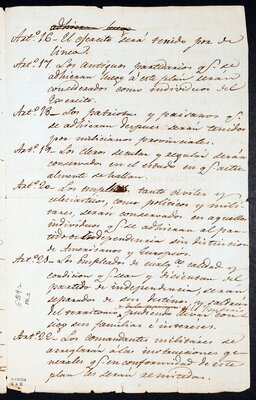
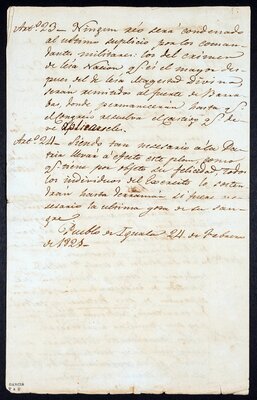
Plan de Iguala
The "Plan de Iguala" was an outline for Mexico's governance that was as bold as the black ink with which it was penned. This manuscript is an 1825 revision of the original document, which was written by statesmen Agustín de Iturbide and Vicente Guerrero in 1821. Having come shortly after Mexico's victory against Spain and full independence, the Plan de Iguala established governing principles for the new nation, serving more as an outline rather than a full constitution. Furthermore, while the plan established liberal principles, such as social equality, it also committed to traditionalism by instituting a monarchy and endorsing Catholicism. While the plan did not last as a governing document, scholar Catherine Andrews argues that it reflected the ongoing tension between liberal reforms and traditionalism that uniquely characterized Mexican state-building efforts.
For further reading: Andrews, Catherine. “Constitutional Projects for the Division of Powers in Mexico during Iturbide’s Empire, 1821–1823.” Journal of Latin American Studies 46, no. 4 (2014): 755–84.